AI Hardware · Advanced Materials
A flexible synapse that learns by association at picowatt power.
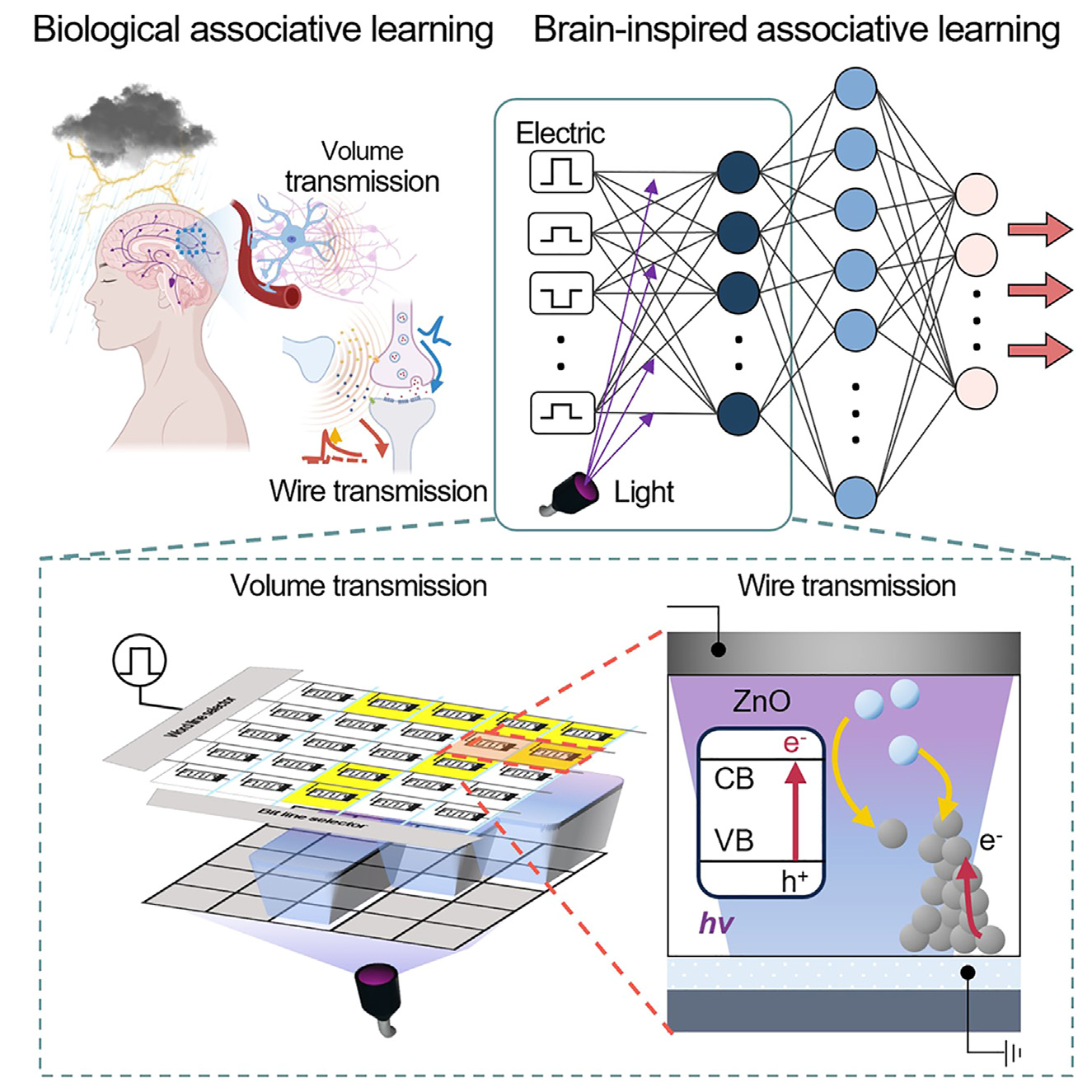
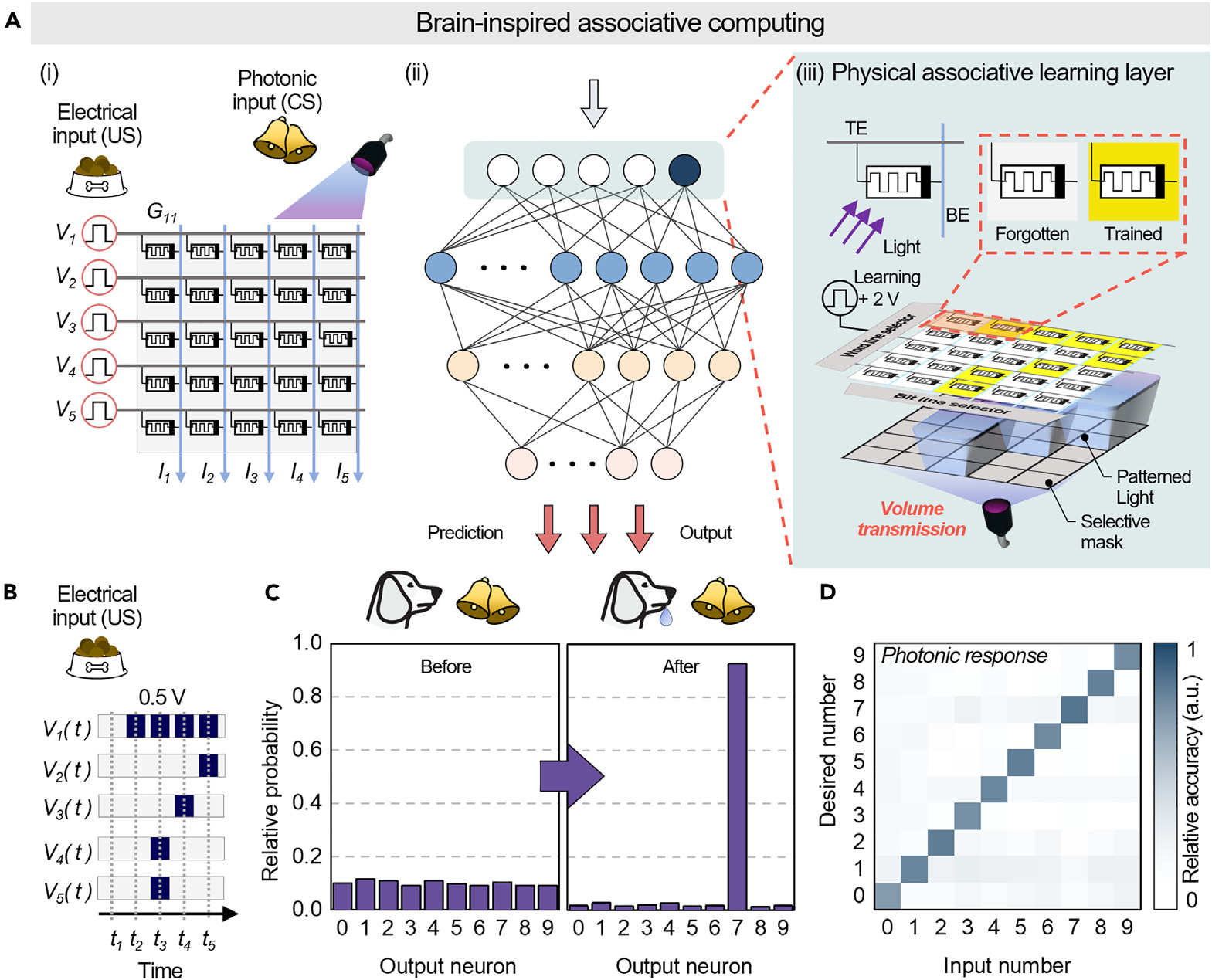
Solution-processed CNT/PDMS and ZnO/PVP memristors that switch on 0.14 nW and pair electrical and optical stimuli into a stable association — the same trick a brain uses. A 5×5 hardware crossbar wired into a small ANN recovers +14 pp of accuracy lost in the data-sparse regime.
- CNT/PDMS
- ZnO/PVP
- 5×5 crossbar
- Photo + electric stimuli
- Keras ANN
- Switching power
- 0.14 nW
- Learning efficiency
- 108 · record
- Endurance
- 104+ cycles
- MNIST @ 90 imgs
- 90% vs 76%
Matter 7(3), 1230–1244 · 2024 Published
Why it matters
Edge AI hits an energy wall: a wearable, in-sensor classifier cannot carry a datacenter power budget, and silicon synaptic elements still train slowly (2–16 min), forget within hours, and are rigid — a poor match for smart skin or roll-to-roll integration.
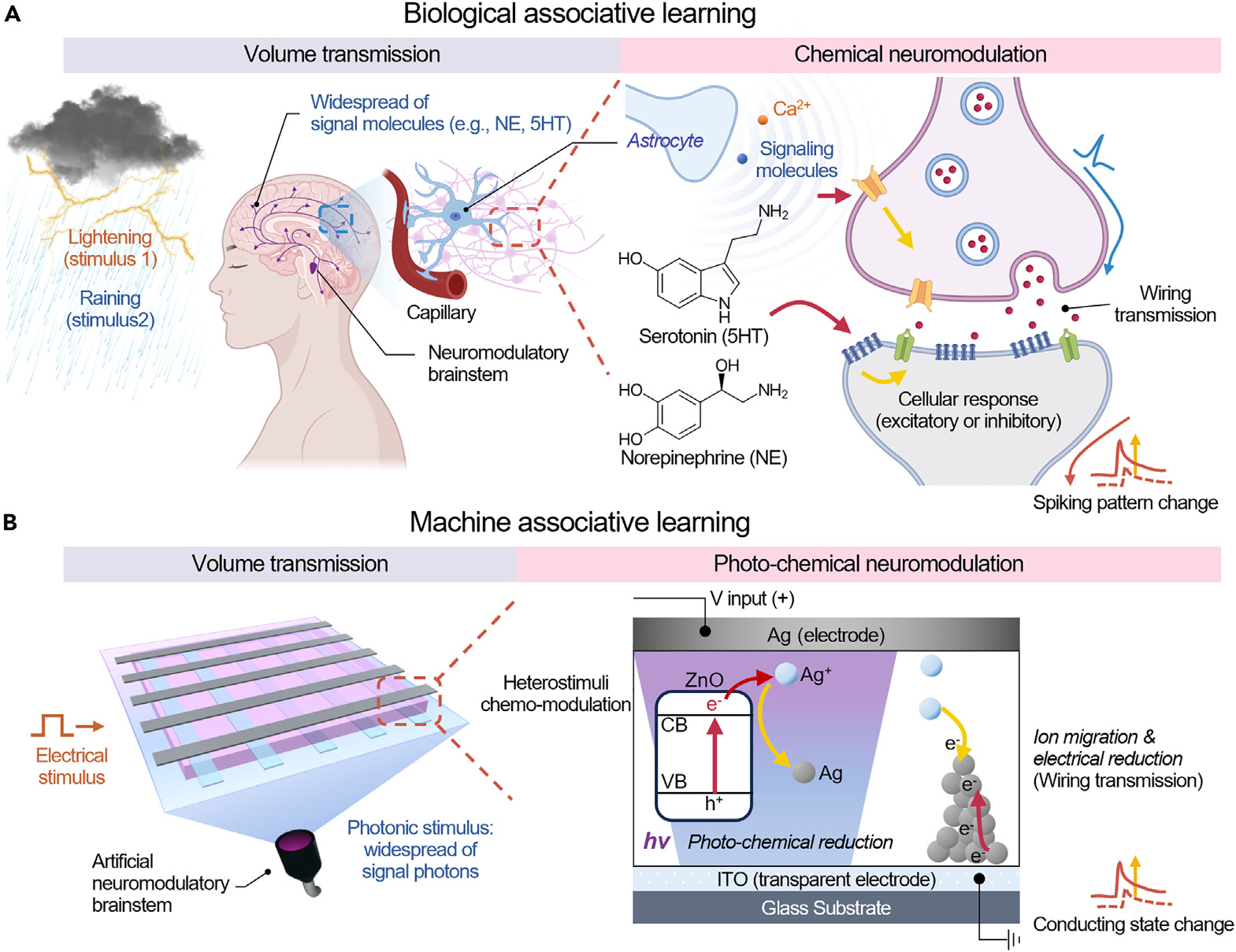
The brain still beats neuromorphic silicon by orders of magnitude in energy and area, in large part because it learns by association across multi-modal stimuli. This work asks whether a solution-processed nanocomposite can do the same — built from chemistry, not lithography.
How it works
- Two device stacks. Au /
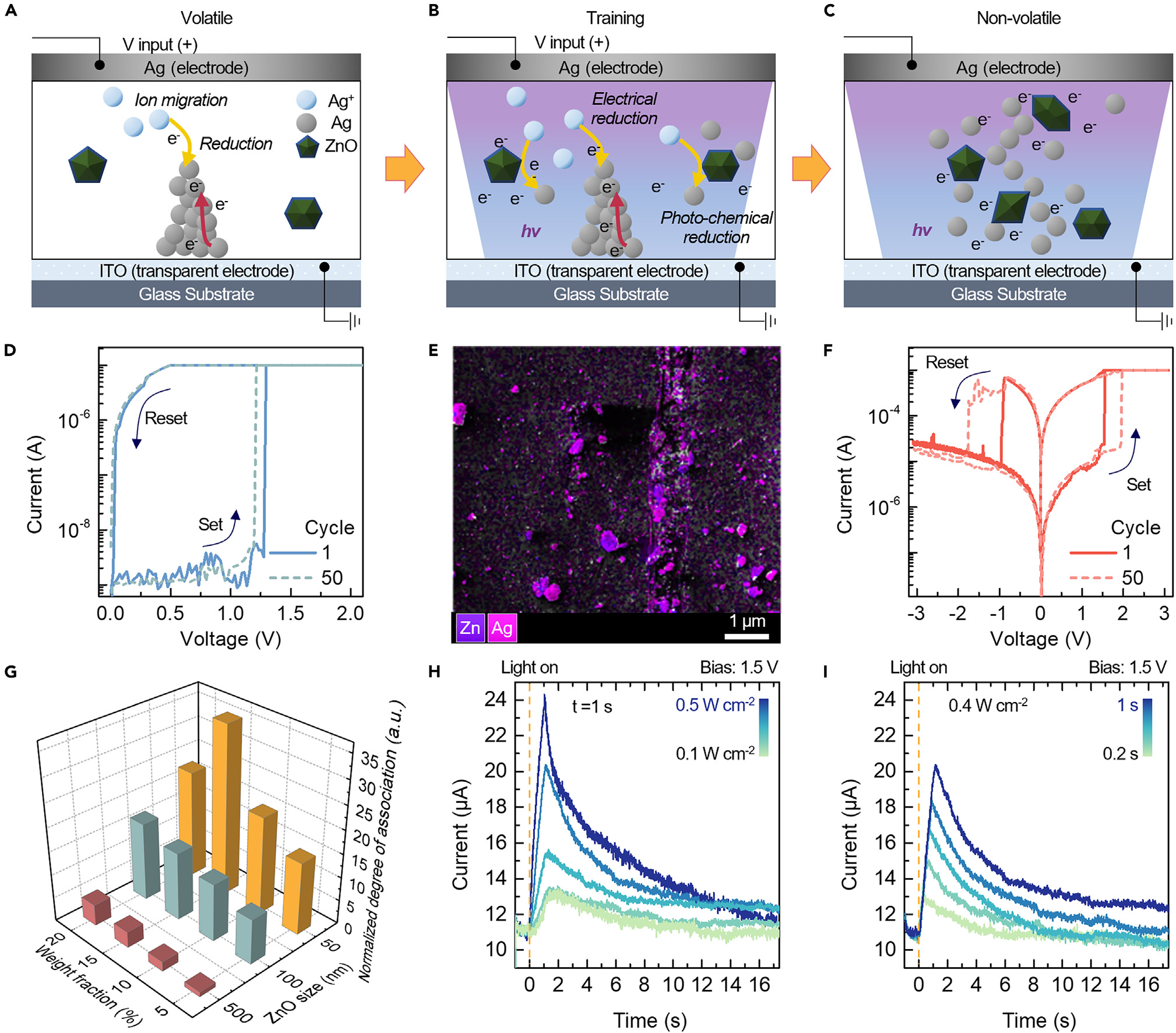
CNT–PDMS/ ITO on PET for low-power flexible switching; Ag /ZnO–PVP/ ITO for photo-active associative learning. - Heterostimuli modulation. Electrical pulses drift Ag+ filaments; UV light triggers photo-reduction inside ZnO. Pairing the two writes a persistent, non-volatile associated state.
- Solution processing only. Tip-sonication, spin coating, thermal evaporation at 10−5–10−7 Torr. No lithography — roll-to-roll compatible.
- Crossbar hardware. 5×5 array integrated into a Keras ANN to evaluate in-sensor computing in a deliberately data-sparse regime.
- Reliability envelope. Cyclic I–V to 104+ pulses, 1 ms pulse-measure, 365 nm UV, bending from flat to
R = 5 mmwith no on/off-current collapse.
What we found
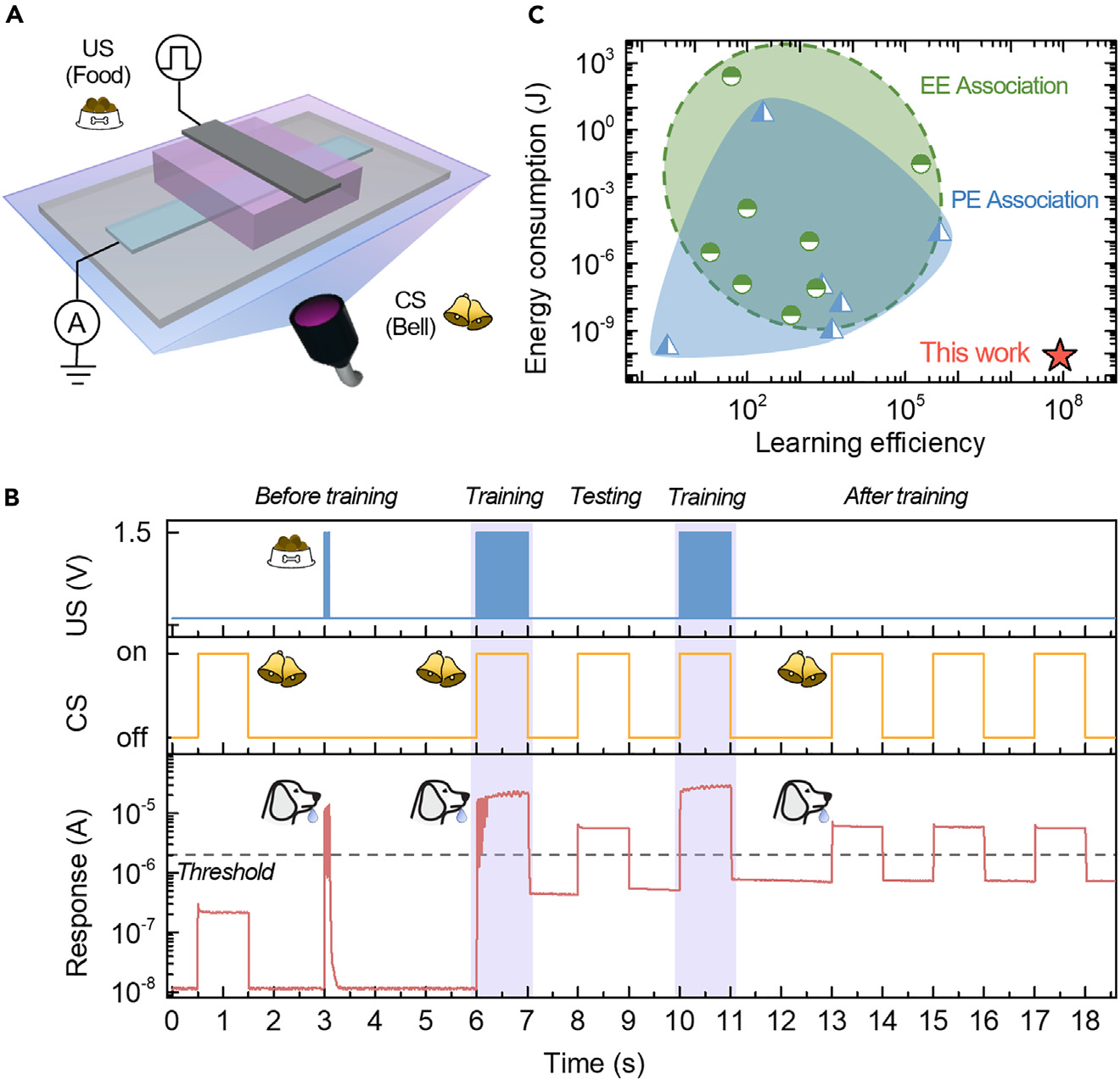
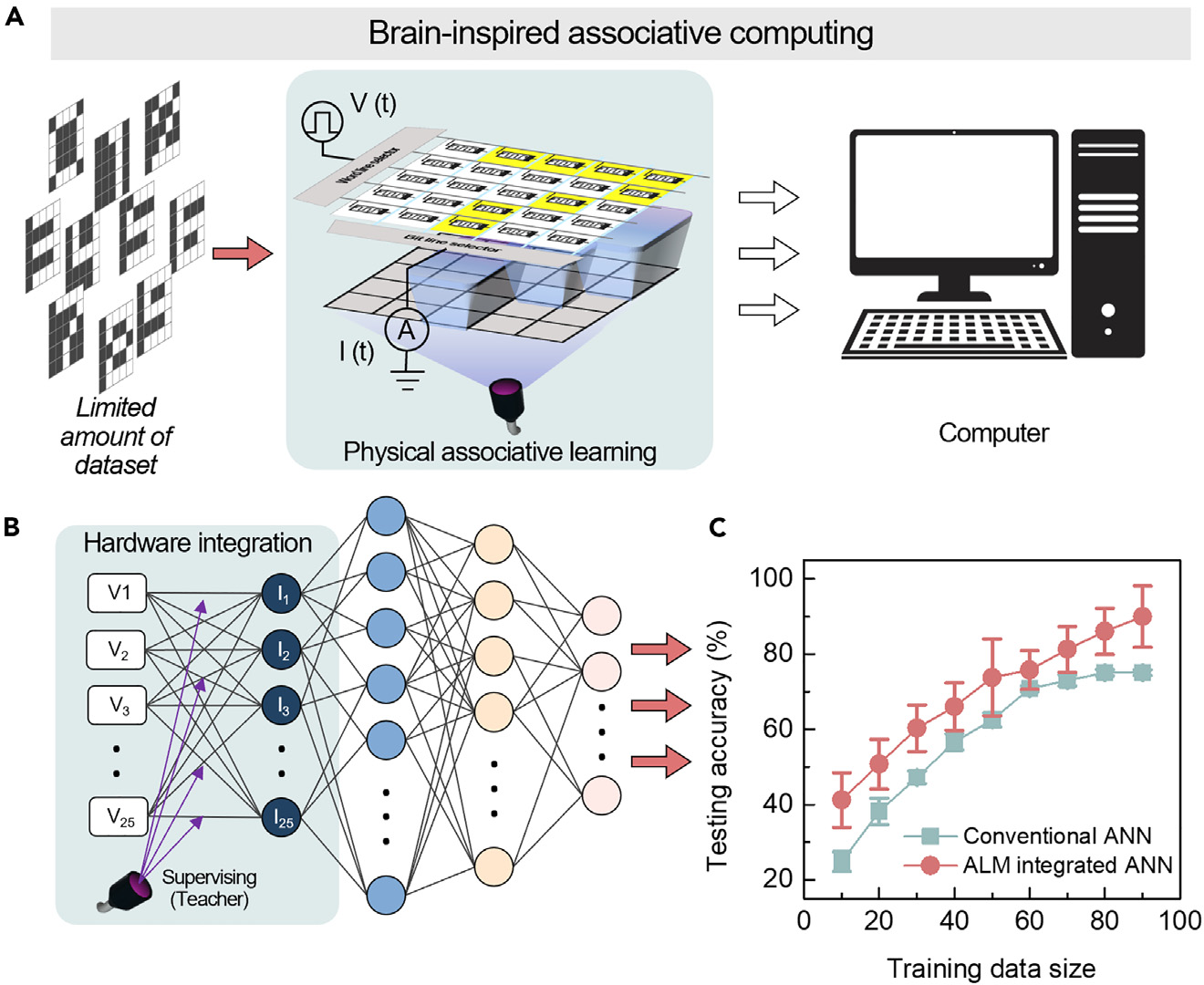
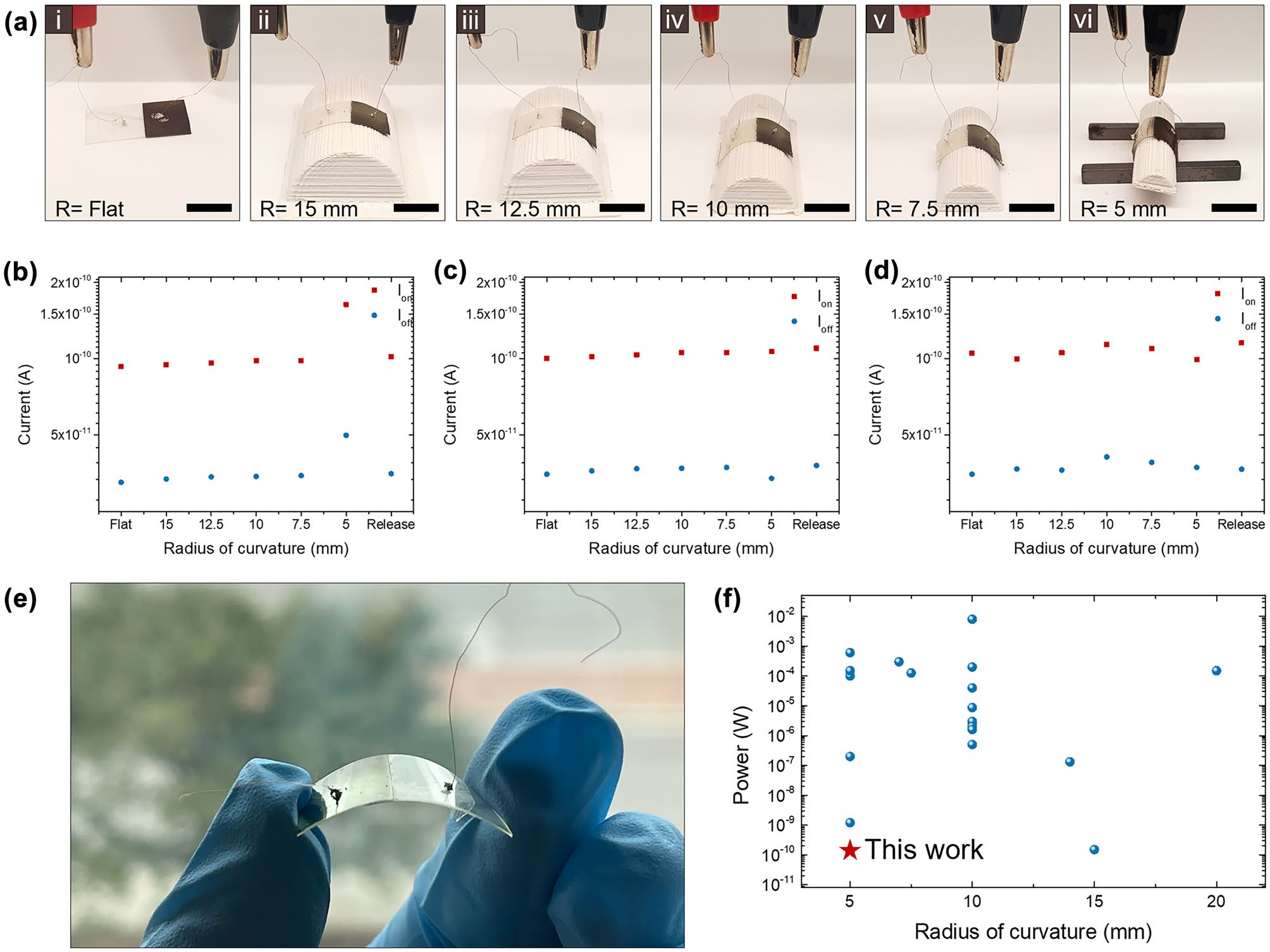
R = 5 mm leaves on/off currents intact across cycles; the device sits orders of magnitude below prior flexible memristors on the power–curvature map.So what. In-sensor pattern recognition on wearable, chemical, and optical platforms without datacenter-scale training. The recipe is roll-to-roll compatible, so it transfers to smart skin, edge medical sensors, and robotic perception with minimal process change.
Paper & resources
Primary article
Matter 7(3), 1230–1244 (2024)
DOI · Matter
10.1016/j.matt.2024.01.008
Companion article
Adv. Composites & Hybrid Mater. 6, 14 (2023)
DOI · Adv. Composites
10.1007/s42114-022-00599-9
Author
Prashant Dhakal
BibTeX · Matter 2024
@article{kim2024heterostimuli,
  title   = {Heterostimuli chemo-modulation of neuromorphic nanocomposites for time-, power-, and data-efficient machine learning},
  author  = {Kim, Jae Gwang and Liu, Ruochen and Dhakal, Prashant and Hou, Aolin and Gao, Chongjie and Qiu, Jingjing and Merkel, Cory and Zoran, Mark and Wang, Shiren},
  journal = {Matter}, volume = {7}, number = {3}, pages = {1230--1244},
  year    = {2024}, doi = {10.1016/j.matt.2024.01.008}
}
BibTeX · Adv. Composites 2023
@article{liu2023neuromorphic,
  title   = {Neuromorphic properties of flexible carbon nanotube/polydimethylsiloxane nanocomposites},
  author  = {Liu, Ruochen and Kim, Jae Gwang and Dhakal, Prashant and Li, Wei and Ma, Jun and Hou, Aolin and Merkel, Cory and Qiu, Jingjing and Zoran, Mark and Wang, Shiren},
  journal = {Advanced Composites and Hybrid Materials},
  volume  = {6}, pages = {14}, year = {2023},
  doi     = {10.1007/s42114-022-00599-9}
}
- Skills
- Nanocomposite synthesis
- Memristor fabrication
- Crossbar integration
- Thermal evaporation
- SEM / EDS / AFM
- Keithley pulse-measure
- UV photostimulation
- Bend-radius reliability
- Synaptic plasticity (LTP / LTD / PPF)
- Few-shot ANN (Python, Keras)
- SCLC transport modeling