Manufacturing ML · Process Engineering
A training-free classifier that qualifies unseen LPBF alloys in seconds.
PIKNN screens laser powder bed fusion process windows in an 8-D physics-engineered space. No learnable parameters, no meta-training — a single handbook lookup per alloy. +18.3 pp over a meta-trained Prototypical Network on held-out Ti6Al4V.
- Physics-informed ML
- Few-shot (1–10 shot)
- k-NN
- scikit-learn
- PyTorch (baseline)
- Dataset
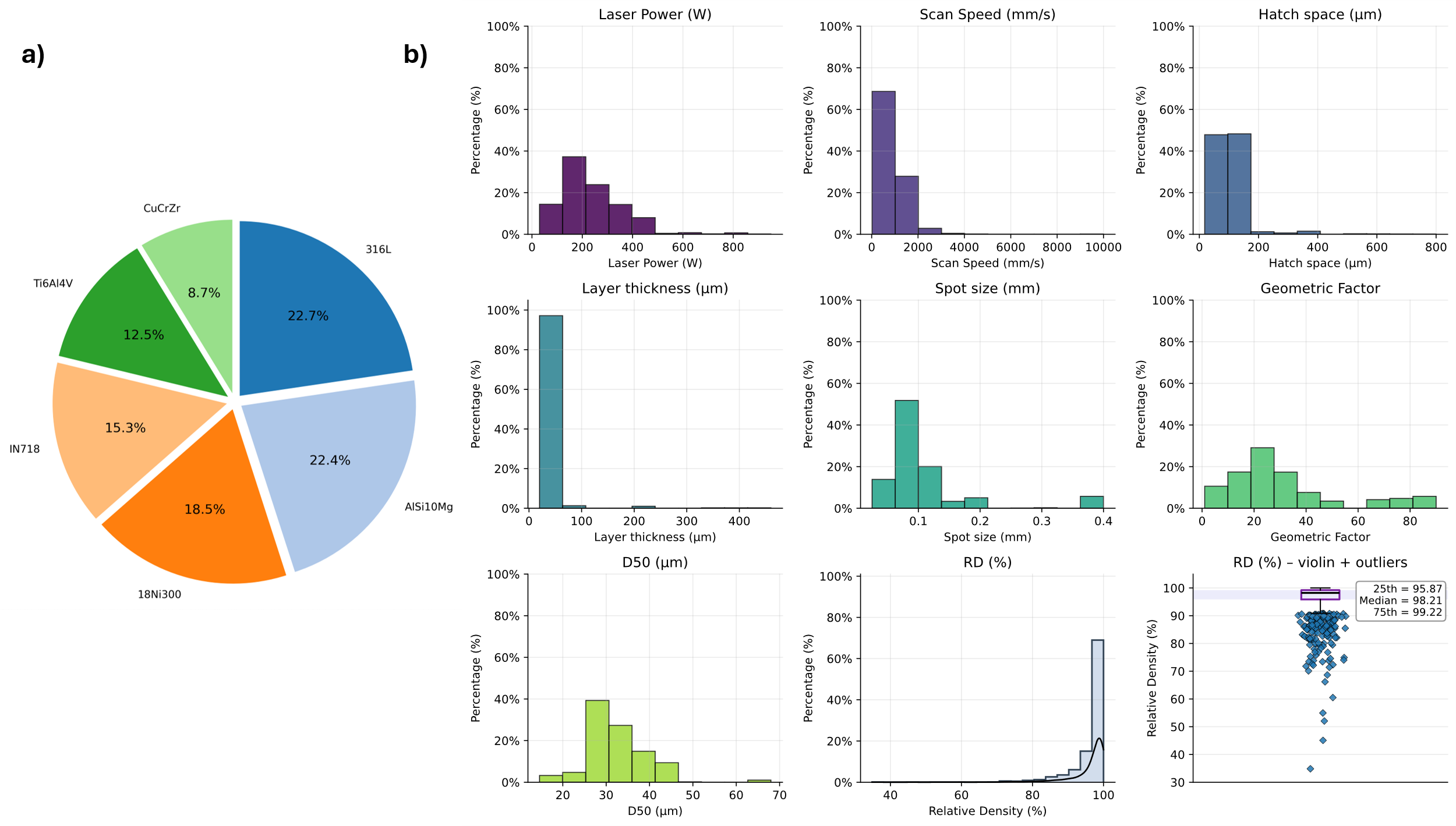
- 1,579 builds · 6 alloys
- Held-out gain
- +18.3 pp
- Separability
- −46% DBI
- Train time
- 0 s vs 11.9 s
J. Intelligent Manufacturing · IISE 2026 Under Review
Why it matters
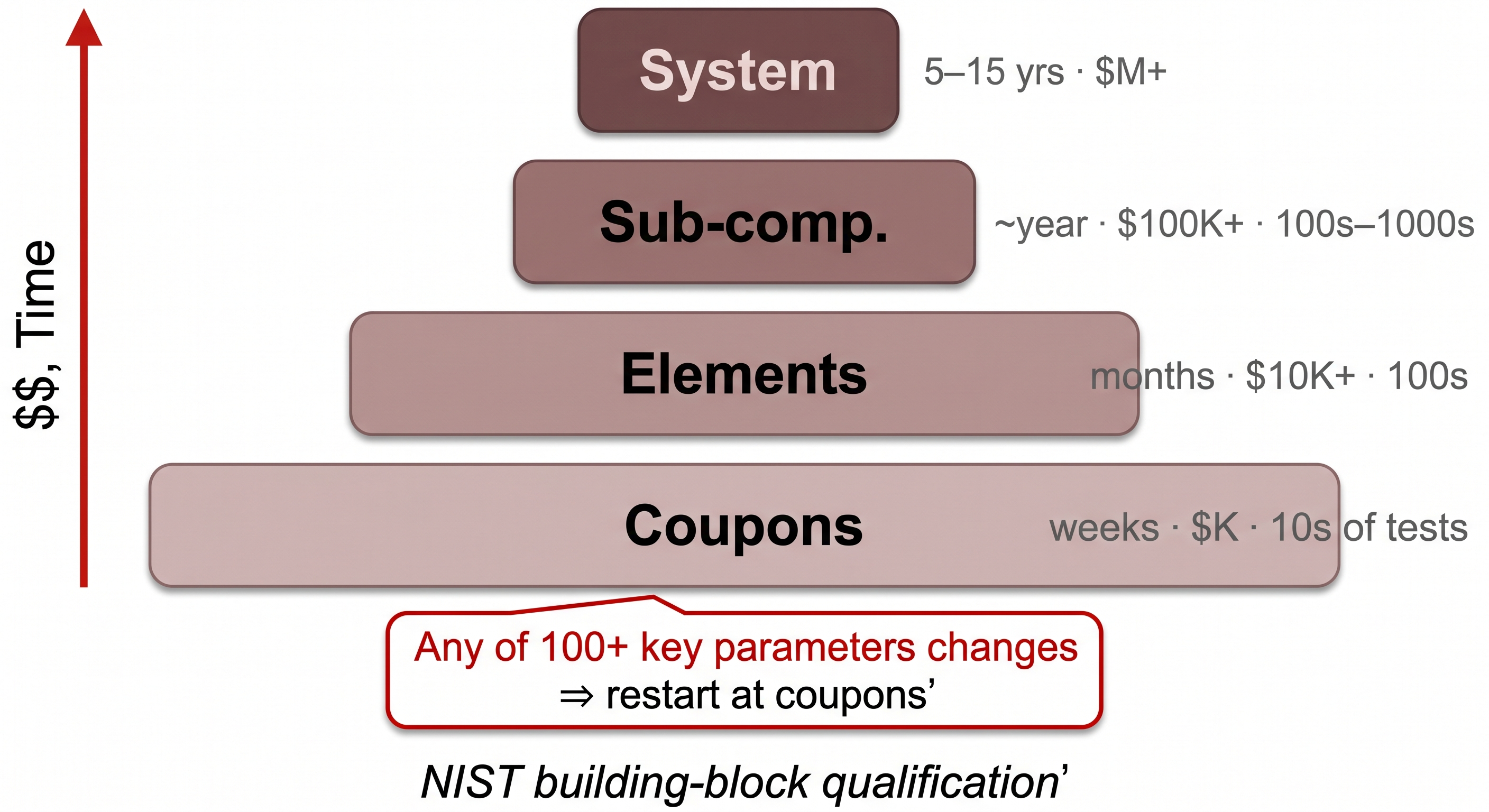
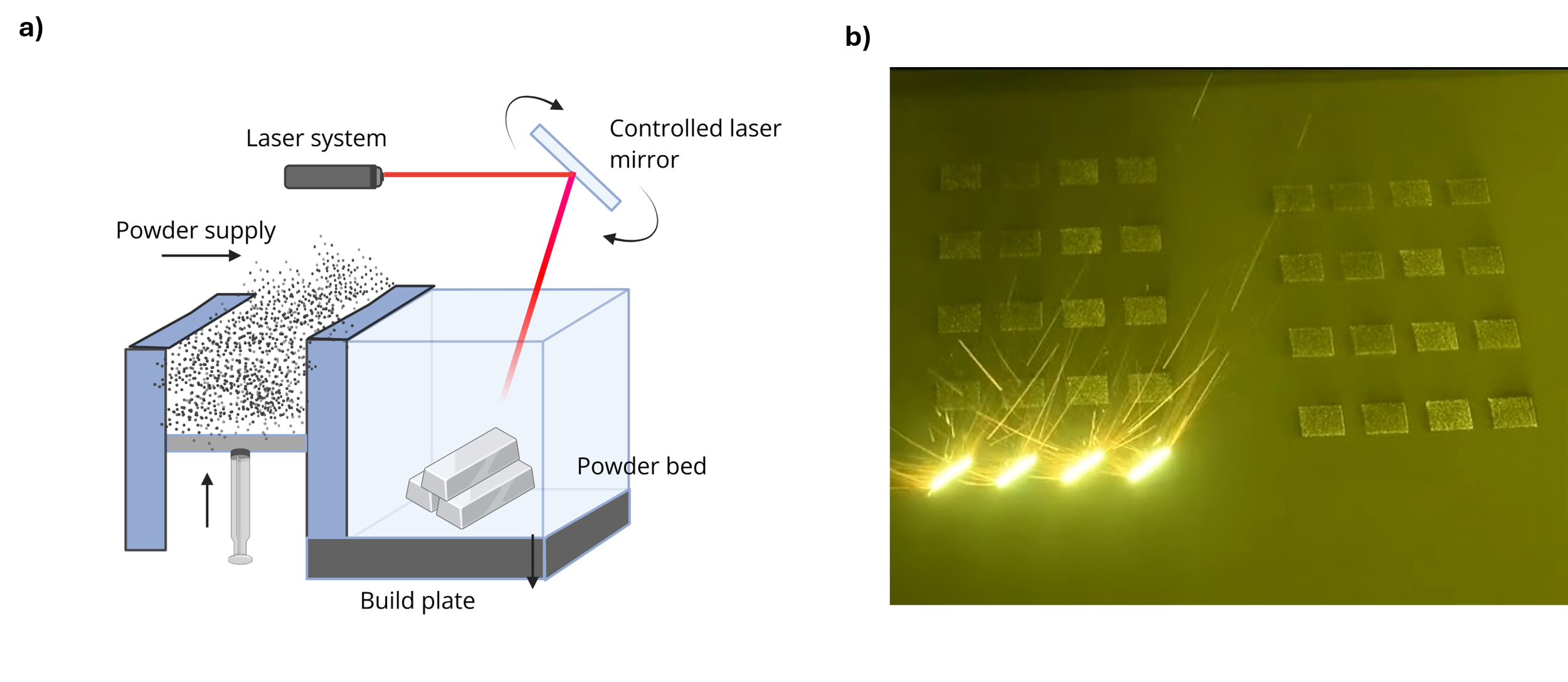
Bringing a new LPBF alloy from lab to certified aerospace production takes 5–15 years and tens of millions of dollars. A single complex component can demand $4M+ and two years just to qualify under NIST building-block protocols, and every new feedstock or parameter shift restarts the cycle.
Conventional ML approaches need 103–104 labeled experiments per alloy to generalize — effectively rebuilding the dataset every time. But the thermal physics of LPBF is already known before any build runs. If cross-material screening lived in physics rather than data, qualification cycles would collapse from years to days.
How it works
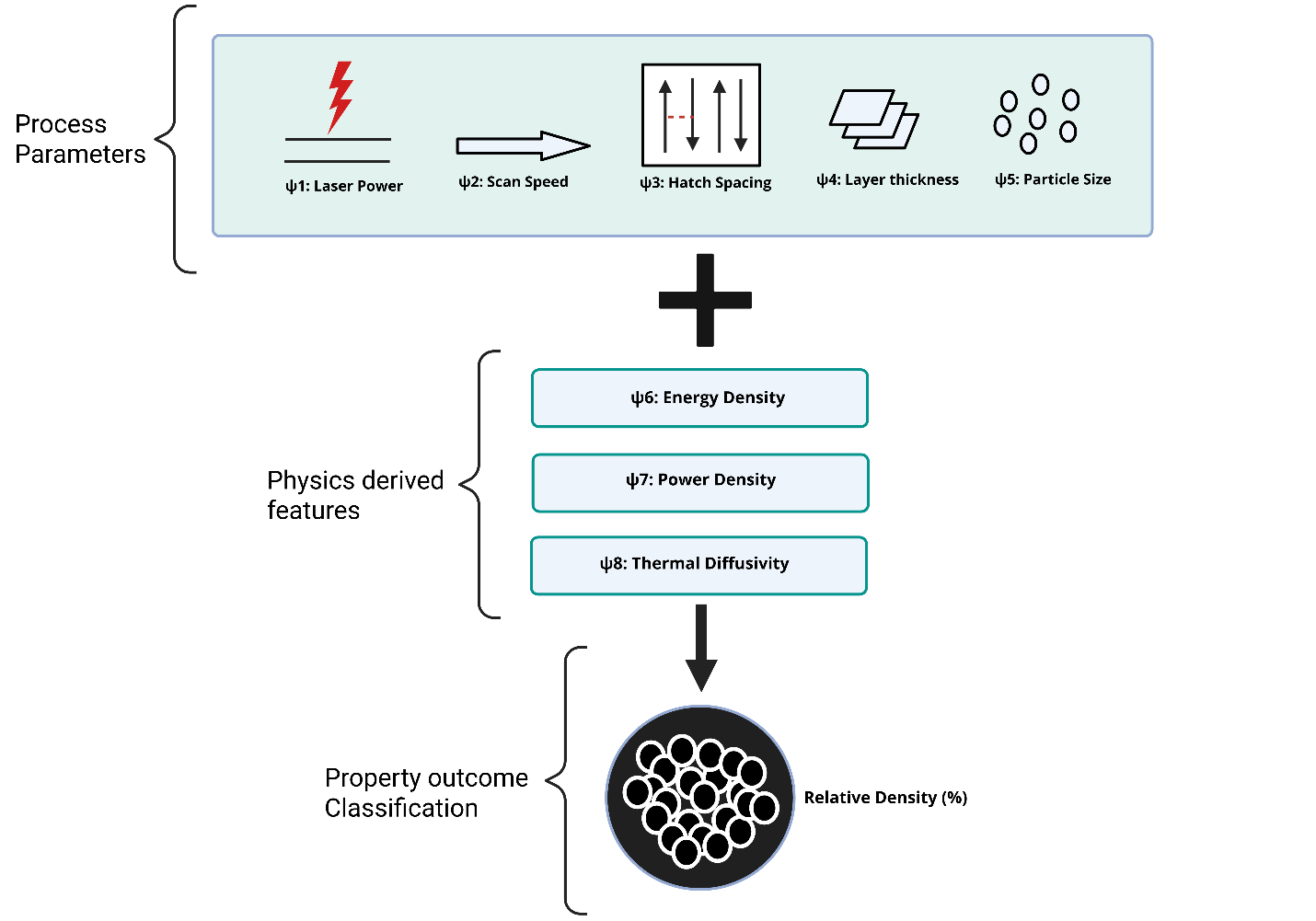
- Process knobs (ψ1–ψ5). Laser power, scan speed, hatch spacing, layer thickness, powder size — the five primary LPBF parameters.
- Derived physics (ψ6–ψ7).
Volumetric energy densitycaptures melting completeness;power densityseparates conduction-mode from keyhole-mode regimes. - Cross-material bridge (ψ8).
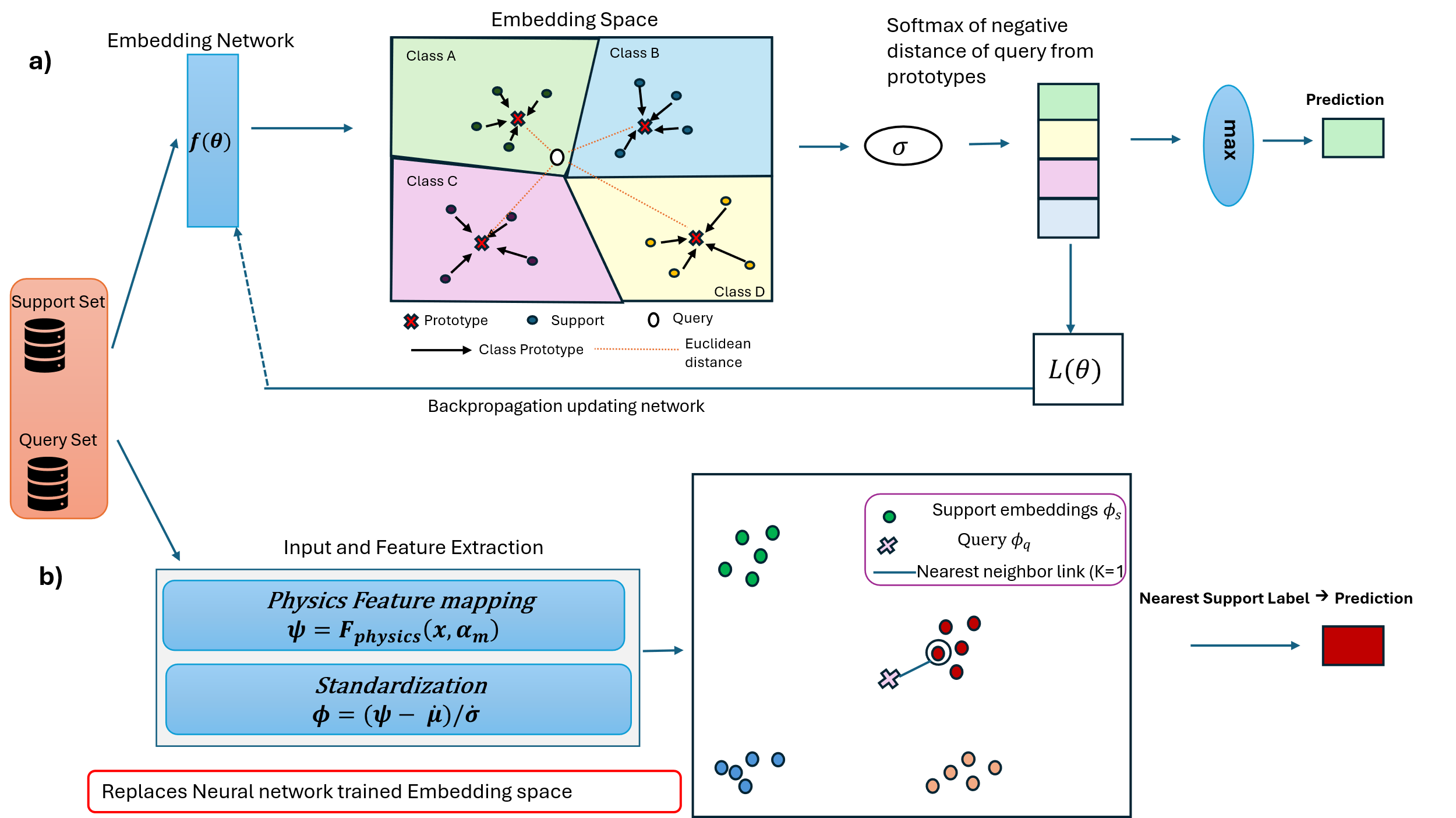
Thermal diffusivity αmfrom a materials handbook carries ~30.6% of squared distance across alloys — the alloy-physics bridge that ProtoNet learns and PIKNN simply reads. - Classifier. 1-NN in standardized 8-D space. Zero learnable parameters, no softmax, no gradient updates — vs. ProtoNet's 13,056 parameters and 10,000 meta-training episodes.
- Validation. 4-way K-shot (K ∈ {1,3,5,10}), 300 episodes per config, 95% bootstrap CIs. Held-out alloys Ti6Al4V and CuCrZr (37× thermal-diffusivity contrast).
Energy density · Power density
ED = P / (v · h · l) · PD = 4P / (πd²)
What we found
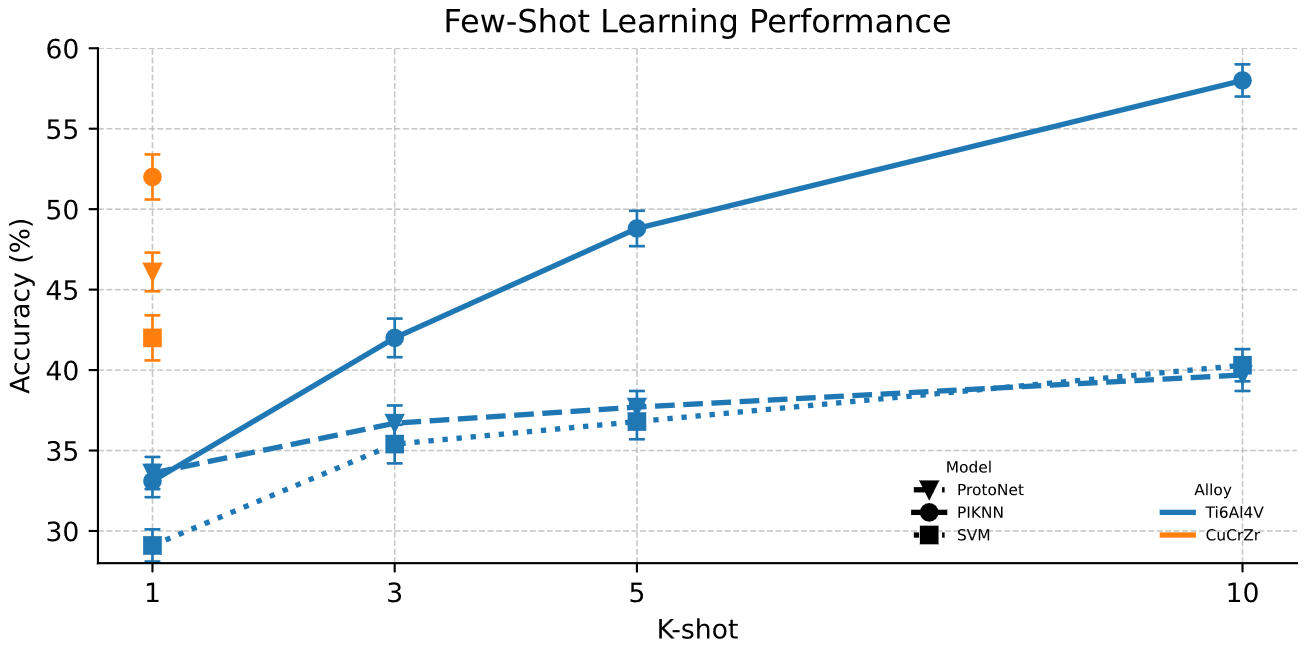
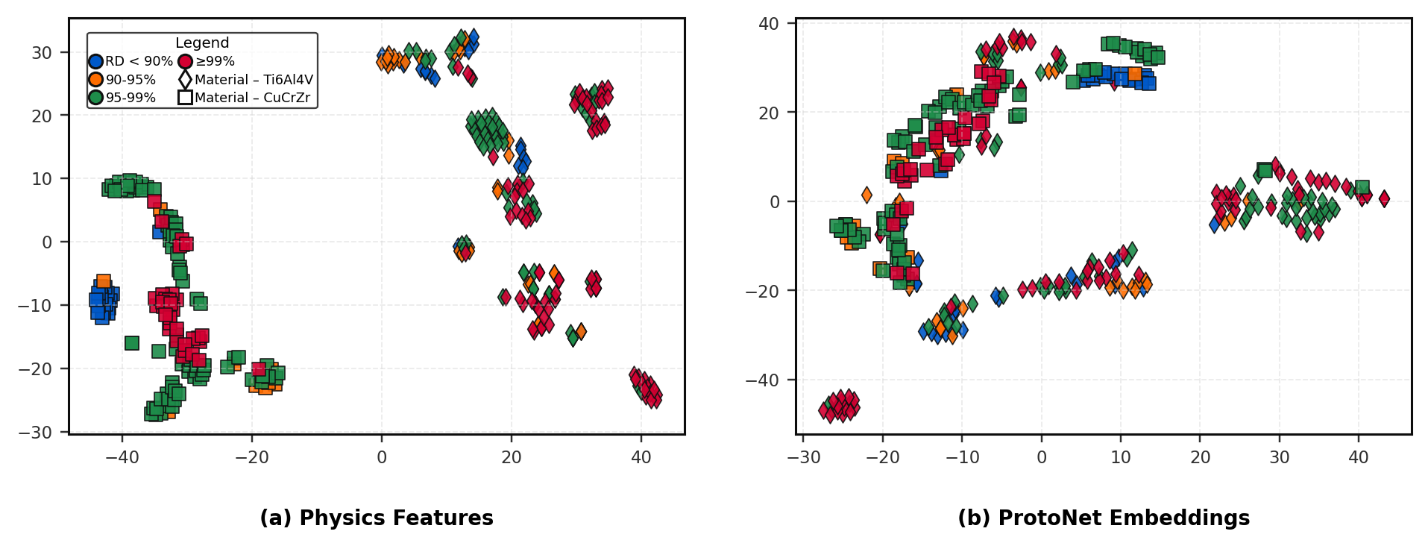
So what. Drop in a new feedstock, look up its thermal diffusivity, run 1–10 calibration coupons — get a process-window screen in seconds. Nothing to retrain when alloys or machines change. Applies anywhere physics is known but data is sparse: aerospace alloys, Cu thermal management, high-entropy alloys.
Paper & resources
IISE 2026 talk
Presentation slides
Dataset (Dataverse)
10.7910/DVN/VPBQK8
Journal version
Under review · J. Intelligent Mfg.
Author
Prashant Dhakal
BibTeX · under review
@article{dhakal2026piknn,
  title   = {Physics-Informed Training-Free Few-Shot Learning for Cross-Material Relative Density Prediction in Laser Powder Bed Fusion},
  author  = {Dhakal, Prashant and Kim, Jae Gwang and Hou, Aolin and Wu, Xiaofei and Wang, Shiren},
  journal = {Journal of Intelligent Manufacturing},
  year    = {2026}, note = {Under review}
}
- Skills
- Physics-informed ML
- Few-shot learning
- Cross-material transfer
- Feature engineering
- LPBF process physics
- Melt-pool / thermal diffusivity
- Davies–Bouldin, t-SNE
- Bootstrap CIs
- scikit-learn / NumPy / PyTorch
- Qualification cost analysis